
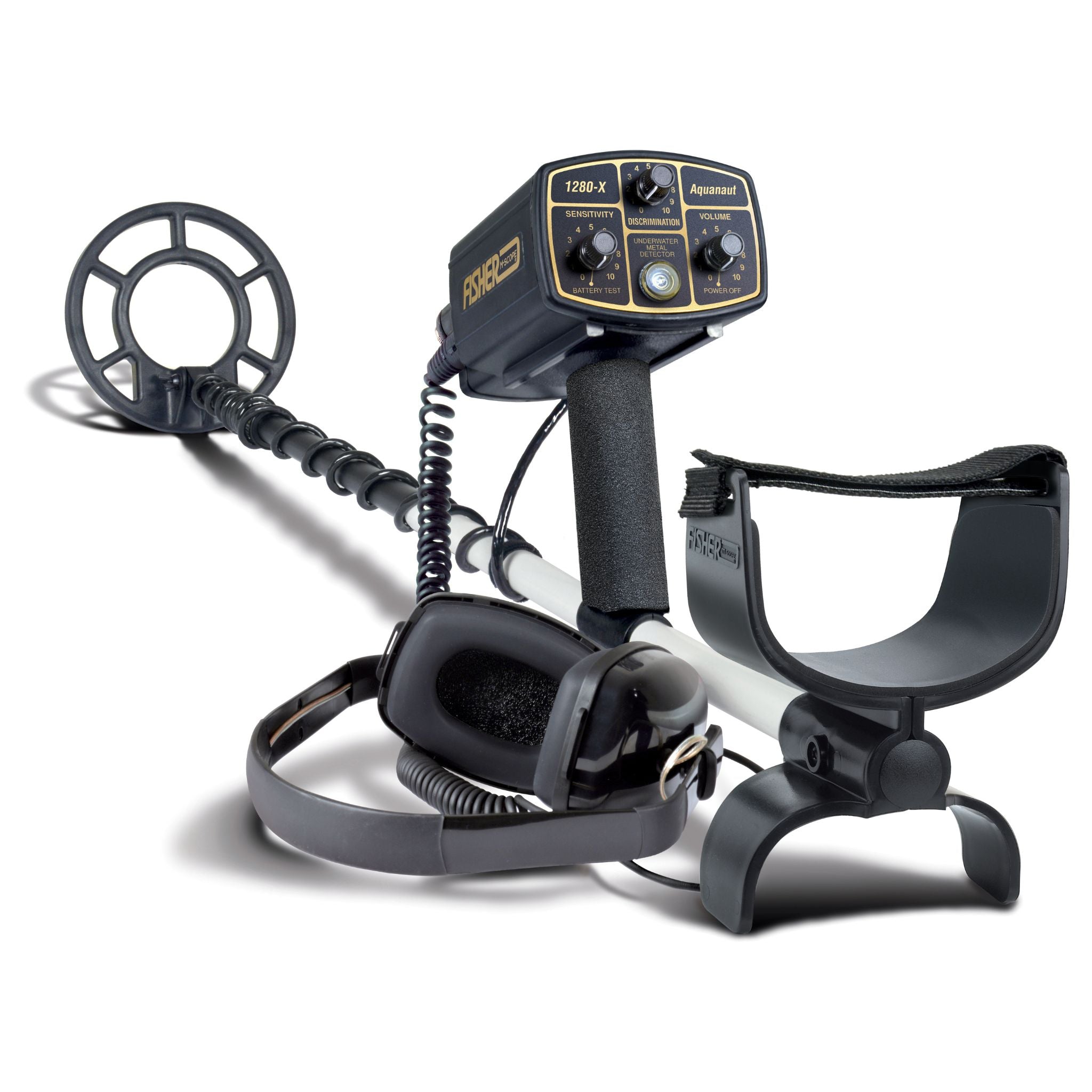

Description
Fisher 1280-X Aquanaut: The Dive Detector That Refuses to Complicate Things
Real dive detectors are rare, and most cost four figures. The Aquanaut has been the exception for decades: a genuine 250 ft (76 m) underwater metal detector, built around one switch-on-and-hunt philosophy, at a price that makes a diver's first detector or a beach hunter's surf machine an easy decision. There is no screen to read in murky water and no menu tree to memorize through a dive mask. Turn it on, set discrimination, hunt.
Why the 1280-X
Three numbers tell the story, and the big-box stores that carry this machine never explain any of them. First, 250 ft (76 m): that is full recreational scuba range and far beyond, with IP68 sealing, in salt or fresh water. Second, 75+ hours: the Aquanaut runs for weeks of hunts on eight ordinary AA alkaline batteries, no charger, no charging clip, no dead lithium pack on a boat ramp at dawn. Third, 2.4 kHz: a deliberately low frequency that stays quiet in mineralized salt water and hits coins, rings, and heavy gold jewelry, exactly the targets divers and surf hunters chase.
Inside the house, the honest ladder looks like this: the Aquanaut is the value dive machine, simple and rugged; a modern multi-frequency dive machine adds finer target separation at a much higher price. If you dive a few wrecks and swim lines each season, the Aquanaut earns its keep immediately; if underwater hunting is your main hobby, we can point you to the step up. Call and we will tell you which side of that line you are on.
Coil choice: the 8 in (20 cm) coil pinpoints tightly and swings easily in current; the 10 in (25 cm) covers more bottom per pass with more depth on larger targets.
Specifications ([A] Fisher factory figures)
| Spec | Fisher 1280-X Aquanaut |
|---|---|
| Submersion rating | 250 ft (76 m), IP68 |
| Operating principle | VLF discrimination, 2.4 kHz |
| Search modes | Discrimination and All-Metal |
| Response | Audio and visual target response |
| Headphones | Waterproof, included |
| Power | 8 AA alkaline; up to 75+ hours |
| Search coil | 8 in (20 cm) or 10 in (25 cm), interchangeable |
| Weight | Approx 5.4 lb (2.4 kg) with headset |
| Warranty | 2 years, Fisher Research Labs |
| Environment | Saltwater, freshwater, land |
What's included
- Fisher 1280-X Aquanaut control unit and shaft
- Search coil per variant (8 in / 20 cm or 10 in / 25 cm)
- Waterproof headphones
- Fisher 2 year factory warranty (First Texas Products)
History Seekers is an authorized Fisher dealer. If you are choosing between the Aquanaut and a modern multi-frequency dive machine, call (256) 284-2247 and tell us where you hunt; surf wading in Alabama and wreck diving in the Keys point to different machines, and we will point you honestly. The story is more important than the artifact.
Frequently Asked Questions
How deep can the Fisher 1280-X Aquanaut go?
It is submersible to 250 ft (76 m) with IP68 sealing, which covers all recreational scuba diving. The included headphones are waterproof for submerged use.
Does the 1280-X work in salt water?
Yes. Its low 2.4 kHz operating frequency is chosen for stability in mineralized saltwater environments where higher-frequency machines chatter.
Why does it use AA batteries instead of a rechargeable pack?
Field endurance: up to 75+ hours from eight AA alkaline batteries, replaceable anywhere on earth. For boat trips and travel hunts, that beats a charger.
Which coil should I choose?
The 8 in (20 cm) coil is tighter to pinpoint with and easier to swing in surf and current. The 10 in (25 cm) covers more bottom and reaches deeper on larger targets. Both are fully submersible.
Is the 1280-X still worth it next to a modern multi-frequency dive detector?
Yes, for most water hunters. A modern multi-frequency dive machine adds finer target separation at a much higher price; the Aquanaut wins on simplicity, battery life, and cost of entry, and it is a true 250 ft (76 m) dive machine. Call us and we will match you to the right one for how you hunt.
Can I use the 1280-X on land?
Yes, it is a capable land detector too, though its low frequency favors coins and jewelry over small relics and gold nuggets.