
By Heath Jones, Owner, HistorySeekers.net
An honest, no-hype breakdown from someone who owns both, uses both, and sells both. History Seekers is an authorized dealer for Minelab and XP. Last updated July 2026.
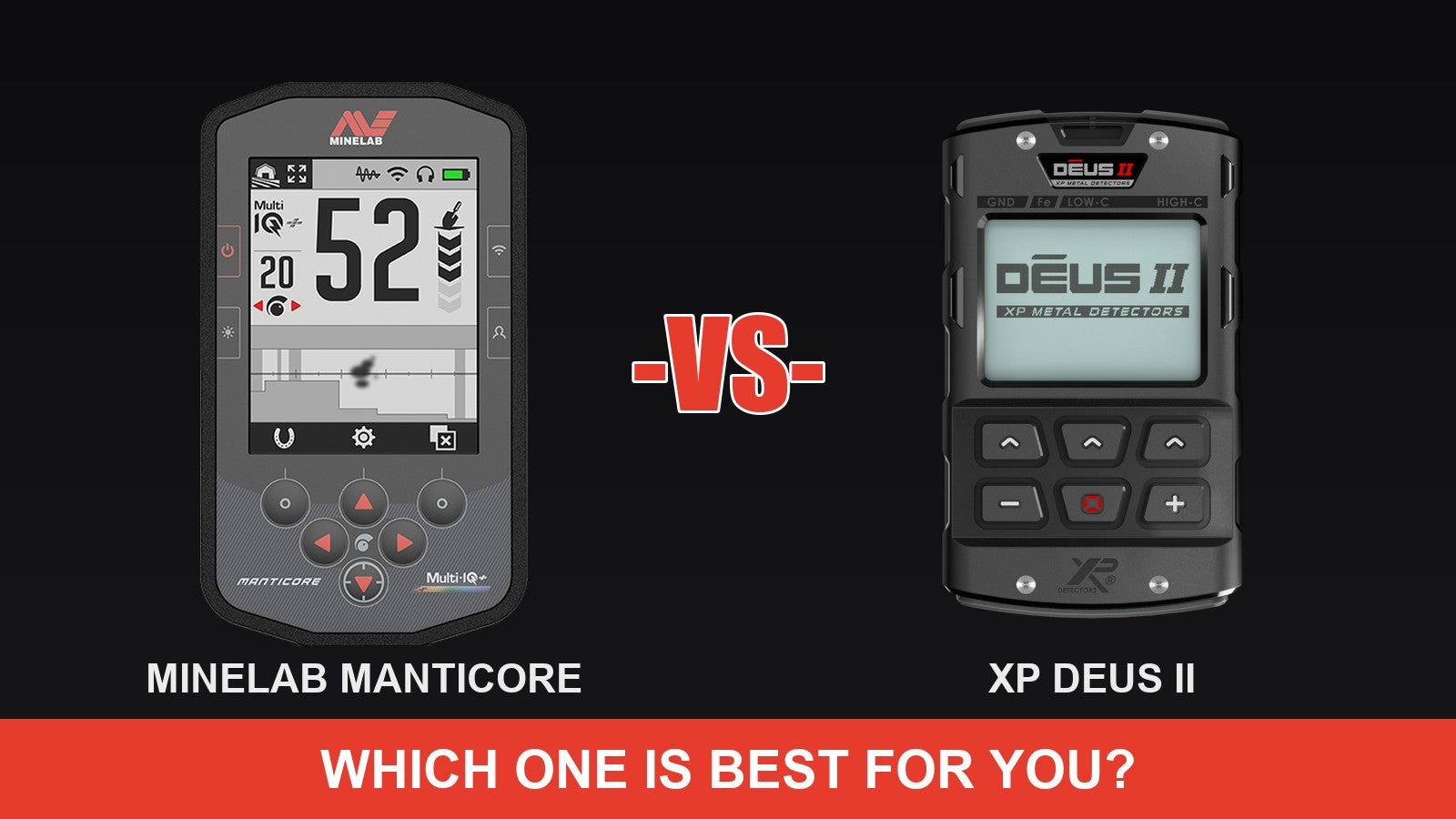
This is the biggest question I get from serious, hardcore detectorists, more than anything else. So I thought I would just lay it all out there. Rather than tell you "go with this one" or "go with that one," the truth is it boils down to your detecting style, what you are going to use it for most, and your willingness to deep-dive the settings.
Back to which one to get. My answer is YES, meaning both, and that is not a sales pitch. That answer is for the ultra-hardcore person who wants choices and has the budget to give themselves the best VLF equipment in the world for almost any kind of history, treasure, coin, jewelry, and yes, even that beautiful yellow stuff we all dream about. Gold will make even us history nerds stop and listen.
But if you can only have ONE of these, my first words to you are this: no matter which you pick, you are not going to be upset, as long as you take the time to learn what it is telling you. That is true of most modern detectors today, especially as we climb into these upper-tier powerhouses. Even the more budget-friendly $900 to $1,000 machines are very good, minus some of the truly high-end features that make these two stand out.
Let me start with my standard line of questions I walk someone through when they are trying to decide.
The scorecard (for the skimmers)
Here is how I score the 16 rounds. Details are below. My scoring lands them a single point apart, Manticore 7 to 6 with 3 ties, which is exactly the point: the right machine is the one that wins the rounds you care about. A relic hunter and a beach-and-jewelry hunter will read this table completely differently.
| Round | Winner |
|---|---|
| 1. Weight | XP Deus II |
| 2. Learning curve & ease of use | Minelab Manticore |
| 3. Heavy iron (speed / unmasking) | XP Deus II |
| 4. Target identification | Minelab Manticore |
| 5. Beach | Minelab Manticore |
| 6. Diving / raw depth in water | XP Deus II |
| 7. Portability | XP Deus II |
| 8. Free updates | Minelab Manticore |
| 9. Charging cables | Minelab Manticore |
| 10. Stability in bad ground | Tie* (see Gold Prospecting) |
| 11. Gold prospecting (micro gold in hot ground) | Minelab Manticore |
| 12. Raw depth | Tie |
| 13. Screen backlight | Tie |
| 14. Headphones | XP Deus II |
| 15. Coils | Minelab Manticore |
| 16. Warranty | XP Deus II (clearly) |
1. Weight
Do you have shoulder injuries or stamina issues where every single ounce matters to you? If yes: the XP Deus II with the 9 inch FMF round coil, or now the XP Deus II Gold that comes with the HF2 coil, is the lightest machine you could possibly think about buying in the high-end market. Take the remote control off the shaft and save even more weight.
Now, if you asked me from perception alone, I would tell you these two are close when you match them apples to apples with the same size coil, and I stand by that in the way that matters: both are lightweight for high-end detectors, and most people would not complain much swinging either one. But you deserve real numbers alongside my impressions, so here they are, History Seekers measured. A few honest notes on method: I weighed in grams for closer accuracy (ounces shown too). These are not new machines out of a box, they are the two out of my detector bags, not disgustingly dirty but with some field dirt on them, and I would call the dirt arguably equal between them. I weighed each configuration four times, zeroed the scale between every weighing, and took a rough average. The Deus II was weighed with the remote attached to the shaft (plus its small lanyard), and neither machine included headphones. One more note: I intentionally left out the larger coils. They are more of an outlier, most people do not swing them nearly as much, and the configurations below are the most used and most sold setups for both machines.
| Matched pairing | Minelab Manticore | XP Deus II | Difference |
|---|---|---|---|
| 11 in, as sold (stock M11 vs 11 in FMF) | 1,324 g / 46.7 oz | 1,125 g / 39.7 oz | Deus II lighter by 199 g / 7.0 oz |
| ~9 in (M9 vs 9 in FMF) | 1,161 g / 41.0 oz | 995 g / 35.1 oz | Deus II lighter by 166 g / 5.9 oz |
| Small elliptical (M8 vs HF2) | 1,184 g / 41.8 oz | 1,004 g / 35.4 oz | Deus II lighter by 180 g / 6.3 oz |
The most fair apples-to-apples row is the top one: the stock Manticore ships with the M11, so M11 versus the 11 in FMF is the comparison as most people actually buy these machines. The pattern holds at every coil size, with the Deus II coming in 166 to 199 grams lighter, call it 6 to 7 ounces. Notice the difference tightens a bit when you compare both with the 9 inch coils. For what it is worth, my 1,324 g Manticore reading works out to 2.92 lb, almost exactly Minelab's published 2.9 lb, so the scale and the spec sheet agree with each other.
Here is the honest framing: weight is perception. Both of these are lightweight machines for high-end detectors, and for one hole the difference is nothing. So ask yourself the question this section opened with: does that extra few ounces mean everything to you? If you have the shoulder, the stamina, and the shorter hunts, you may never notice it. If you grind out 8 hour days, it is real. But from a strictly math standpoint, the lightest weight detector point goes to the Deus II. Point: XP Deus II.
2. Learning curve and ease of use
Do you run a smartphone with some level of proficiency? If the answer is yes, neither of these detectors is hard to use on the factory presets. Over the past six years or so, manufacturers have built them with what I call training wheels, and even on those presets both are exceptional metal detectors. Gone are the days of high-end machines like the White's V3i, which was amazing for its time and honestly ahead of the curve, but unless you were a rocket surgeon with a pre-flight checklist like an astronaut, you spent more time tweaking settings than detecting. That was my experience, anyway.
Here is where the rubber meets the road. Once you have learned to ride your new bike, err, metal detector, you are ready to shed those training wheels. That means going into ultra-nerd detectorist mode and pulling every ounce of raw power out of the machine. Learning what each setting does and how it affects the detector is key, and this is not a master class on either one. I have many hours on both and use both efficiently, but I have to give the nod to the Minelab Manticore on ease of use. As you dive into the advanced settings, its interface is the most intuitive in the business right now: the menu is laid out so you can find a setting and adjust it without hunting for it, and the whole thing becomes second nature fast. The XP Deus II is not hard to use, I just find most people cannot remember which button corresponds to which setting or where they are in the menu. And some of that weight savings had to come from somewhere, so the smaller screen makes those changes a bit more tedious. Point: Minelab Manticore.
3. Heavy iron trash (speed and unmasking)
How does each do in heavy iron? I am not talking about a few nails in a yard here and there. I am talking about a 1700s colonial cellar hole with blankets of nails. Both have blazing-fast recovery speed, which is how fast your detector resets and can hit another target after you pass over one. In my opinion the XP Deus II is slightly faster in heavy iron, and I have picked out small items that most other detectors would likely miss, using high reactivity (XP's term for recovery speed) and a small coil. That does not mean the Manticore is out of the race, because it very much is in it, and it is not a blowout. Skill with either unit can easily make up the difference. When I am heading to an iron-infested site looking for small, hard-to-hear targets, I usually reach for my XP Deus II with a small coil. But that leads us to the old law that for every action there is an equal and opposite reaction, so let us jump to the next point. Point: XP Deus II.
4. Target identification
This is where most people realize the statistical tie, but you are going to start drifting down either the XP road or the Minelab road depending on YOU, your style, and maybe your limitations. Both detectors have a form of identification: the Deus II with its XY screen, which I find few relic hunters use, and the Minelab with its graph that plots the conductive value of the target AND the ferrous scale. That gives you a graph with a black line across it, and if you see a good round plot on that graph, you had better be digging it. Not to say it is never a pull tab, but it could also be a gold ring. I just find myself digging less trash with my Manticore.
Now do not get me wrong, my Deus brethren, you know I love it too, and some of you can really pick out the trash on the Deus II. But for most people with less than superhero detector abilities, they tend to find the Manticore the better cherry picker's dream. This matters to those of you who, for health reasons, age, or just not having the time to waste digging extra targets, would rather have a better idea of what the target is before you dig. You will lean Manticore. But you relic hunters, and those of you who dig so many good targets off iffy signals on ANY detector, you know the detecting game can be a game of numbers. More holes equals more chances at the find others overlooked or bypassed, and you folks are going to lean Deus II. Point: Minelab Manticore, with a big caveat that it depends on YOU. Honestly, which one I grab depends on the day and where I am.
5. Beach detecting
Outside of a pulse-induction machine or a specialized dive detector, the average person detecting the surf or dry sand will find both of these detectors incredibly stable and capable, to the point I would call it a tie on pure performance. But there are other factors. The lighter weight of the Deus II can actually be a slight disadvantage for me in the surf (personal preference). I will confess I am not a veteran beach detectorist, and most of you probably have more experience than I do here, since I am at home in the woods searching for relics.
I personally love that the Deus II is completely wireless, and the bone-conduction headphone technology for the water is fantastic. But I would be neglecting you if I did not bring up the elephant in the room. True wireless from the coil to the remote is really nice, BUT it comes at a cost. When you put that XP coil under water, about 2 to 3 inches or so, the signal cannot travel through the water and you lose the connection. XP has a fix, and it comes with your Deus II for FREE: the XP antenna system. You attach it with what amounts to a rubber band, then wrap your previously wireless detector with, gasp, a wire running up to your remote. I just find it clunky, but I get it. It is a technical trade-off for being wireless on dry land. Science and stuff. So I am awarding this point to Manticore. Do not worry, XP fans, it is not over yet. Point: Minelab Manticore.
6. Diving and raw depth in water
This one comes down to how deep you are going. I am not a diver, but I can do math. Under about 15 feet, the Manticore is fine. Over 15 feet, the XP Deus II is your detector, all the way down to 66 feet. You will have to connect that antenna, but having a multi-purpose detector that can go that deep is the clear choice for depth in the water. Raw depth-in-water winner: XP. That said, it may not be a factor for you, and it is not for me. Again, it depends on how that relates to your hunting. Point: XP Deus II.
7. Portability and collapsed form factor
Fly or travel a lot with your detector? Backpack into your spots? Any XP fan who denies that the light, compact, wireless Deus II platform is well done is being intellectually dishonest with you. The XP Backpack 280 and the smaller Backpack 240, paired with this platform, are just done right. Every item has its spot, with room for the XP gold kit, gold pick, shovel, multiple coils, your firstborn, you get the picture. I have both packs and use both, but I lean toward the bigger, heavier Backpack 280, because I would rather have it and not need it than need it and not have it. You minimalists will be perfectly happy with the Backpack 240.
Having said that, Minelab just this year (2026) came out with a nice backpack that has a good amount of storage and some great features. I can fit a GPX 6000 and a Gold Monster 2000, or a Manticore, in it at the same time. At the time of writing, you can only get that Minelab backpack as part of a bundle, and various detectors have it bundled in, which is a great deal if a backpack matters to you. No word yet on whether they will ever sell it separately, though I suspect at some point they will. The point still goes to the XP Deus II here on style. Point: XP Deus II.
8. Free updates
Both companies offer free updates, so that part is a tie, but it is more than that to most of us. Minelab does not release as many updates, and they are usually to fix a bug if one is discovered. XP tends to release more updates, faster, and most are geared toward making their detectors compatible with new items, which is not a bad thing. You need the proprietary cables and chargers for BOTH units to update them (more on that charger situation later).
First, the Manticore. It has you plug the USB-A side of the cable into your computer and attach the magnetic charger to the Manticore, then run the downloaded installer. Quick, easy, efficient. Most people do not know you can also update the headphones. I am not sure exactly what it does, and they work even if you do not update them, but the option is there and it is easy over USB-C.
Now, XP Deus II updates. Buckle up, buttercup. I am not hating on XP here, I use one a lot. The updater walks you through the steps with pictures, and the remote update is not bad. But depending on which headphones you get, this is where the rubber meets the road. You MUST update the headphones too, because if you do not, they will not pair back to your detector until the versions match. The WSA-ST (behind-the-head) and WSAXL-ST (full size) are easy to update. But unless you do it a lot, I find navigating the menu on the WS6-ST clunky and not intuitive at all. I wish XP would make their updates easier. Point: Minelab Manticore.
9. Charging cables
The Minelab Manticore magnetic charger is actually pretty nice. Just make sure little rust bits do not get caught on the magnet, or your detector may not charge. It is magnetic, and it is proprietary, so do not lose it or you will most likely be waiting on a shipment unless a local dealer has one. One cool factor: while it is proprietary to Minelab, the same charger works with most of their newer detectors and even some discontinued ones, like the original Equinox series. So if you have been in the Minelab family a while, you may already have spares.
The XP charging system, for a wireless detector, looks like a mismatch of wires and connection types, mostly proprietary. The USB-A cable splits three ways: a round proprietary connector to the remote, and two old-school USB Mini-B connectors that used to plug into their now-discontinued headphones. The other plugs into a plastic clip that breaks more than it should, and being proprietary, I recommend buying backups when you order other parts. You will eventually need one. Every part of their system is sold separately, at least. Then there is the charging cable for the HF2 coil, which is, you guessed it, a different proprietary cable, not the same as the one for the other coils. One end is USB-C, just not the end that connects to the battery. You get the picture. At least their new headphones charge over USB-C, and the coil charging clip for most of the coils works if you kept the one from the Deus I.
Right about now, after that rundown of XP chargers, you are probably thinking Minelab wins this one. You are right, and between these two the Manticore's magnetic charger is the simpler story: cross-compatible across most of the newer Minelab family and less to fuss with in the field. And let me ease up on both of them for a second, because honestly neither is doing anything wrong, they are just each a little comfortable in their own proprietary world. Here is the friendly ribbing, though. Garrett will sell you a fully waterproof, multi-frequency machine for around six hundred dollars that charges off the very same standard USB-C cable as your phone. So if a mid-range Garrett can put standardized USB-C on a waterproof detector, our two flagships can absolutely get there too. I am not mad, I am just standing here holding my Garrett Vortex VX9, a phone cable, and a knowing smile. You wanted honesty, not sales hype, right? You landed in the right place, the No-BS zone. Point: Minelab Manticore.
10. Stability in bad ground
Both detectors have noise-cancel abilities to help you avoid or at least manage EMI. That is pretty much industry standard now. Both are multi-frequency machines that handle even extremely mineralized ground well, and both get about as much depth as you can expect without moving to a specialized pulse-induction detector. Minelab was the tip of the spear in making multi-frequency an industry standard, and many companies use some form of Minelab's earlier technology now that the patent has expired. I am not sure exactly what tech XP is using, but it is a solid competitor no matter what.
Here is the way I want you to think about it: both are stable, but you have stable... and then you have STABLE. Picking out a larger target like a coin at depth is easy when you have a quiet-running detector, and both of these run quiet and do that job well. The real test comes with the harder-to-find things in bad ground, where the difference between stable and STABLE starts costing you targets. Both are good, but if that applies to you, you want to read the Gold Prospecting section next. Point: Tie, with something of an asterisk (see Gold Prospecting).
11. Gold prospecting
Both machines look great on paper here, and both have a dedicated Gold Prospecting mode. The XP boasts a super-high frequency range when running the HF2 coil. In air tests it hits small sub-gram pieces with no issues, and so can the Manticore. But air tests are not the end-all of testing, as we all know. The ground is what really makes the difference.
I mentioned in the stability section that both are stable on hot ground, and that is true. But hearing a Civil War Minie ball in hot ground is a different thing than hearing a micro-small piece of gold in hot ground. Every click and pop must be processed by your ears. This is where I think the Minelab Manticore and its Multi-IQ technology excel. I can hear small gold with the Deus II and the HF2 coil, but in hot ground the smallest pieces can get lost in the noise. Now, I want to be transparent, because that could be a settings issue on my end. While I have absolutely detected for gold, I have far more years in the field as a relic hunter, and with more seat time on the Deus II I might close that gap myself. So weigh your own experience, and your patience for tinkering, as you read this. In my hands, though, I found it easier to pull micro-small gold with the Manticore running the M8 coil. That gold would come in right on the line, or just under it, on the graph, giving me a good, round, consistent plot in that 1 to 3 range depending on the size and shape of the piece.
There is a bigger point hiding in that. A lot of everyday prospectors do not want to live in a settings menu, they want a gold mode they can turn on and go with, and Minelab has spent years making gold prospecting more approachable. It shows here. In fairness to the XP, this is about what I could do with each machine, not a hard ceiling: on frequency alone the HF2 reaches higher, up to 90 kHz simultaneous and 120 kHz single against the Manticore's 40 kHz, and in the right ground on the right settings that is a genuine small-gold advantage. But I am giving the point to the Manticore because it was easier for me to hear and confirm that micro gold in hot dirt, and because between the graph, the ease of use, and that Multi-IQ technology, it is the more approachable gold machine for most people. Point: Minelab Manticore.
One more honest note: if gold is your primary target rather than a side pursuit, a dedicated gold machine like the Gold Monster 2000 or the GPX 6000 goes further than either of these. But that is its own blog post.
12. Raw depth
So many factors go into this that it can honestly be subjective, and it should not define which detector you choose, because it depends so much on settings, frequency, soil moisture, and on and on. It is hard to give a clean answer, and anyone claiming you can hit a dime at some exact number of inches is lying to you. There are too many variables. I have dug targets with both detectors at extreme depths. Because their recovery and reactivity settings are not numbered the same, it is hard to judge unless you set both to the absolute lowest reactivity and then test the extremes, and even then, what one ear hears may differ. With the stock coils being the same size, I am not going to render a judgment here. Opinion-wise, I usually reach for the Manticore when I am hunting deep coins and the Deus II when I am hunting deep artillery shells. I will add that I like that XP includes an audio setting that amplifies the signal of a target. You can essentially make a deep whisper sound like a hubcap on the surface, which has its place, but not at every site. We will call this a tie and leave it to you, factoring in your other categories. Point: Tie.
13. Screen backlight
Both have backlights. They are flagship detectors. Point: Tie.
14. Headphones
As I mentioned, XP has many headphones to pick from. One thing up front: the new stereo audio for the Deus II. When it was first announced, I was skeptical. They claimed you could run different settings in each ear, and I thought it was hype at first, so I resisted, even when it launched. I finally tried a pair, and WOW. This is advanced stuff, and it is off by default. If you are ready to go deep into detectorist nerd mode, dive in. You can run two different reactivities, one in each ear. That is like covering the same ground set for deep targets and shallow targets at once, without giving up anything, and nobody else in the industry is doing it. That is just one feature. Honestly, this deserves its own blog post, so I will stop there and just say: if you are not afraid of advanced settings, get ready, because you want this in your life. And for those who feel technically challenged, it is off by default, but it is there if you ever feel froggy. Ribbit.
You can customize your XP package with various headphones to fit your needs, so there is no single standard headphone. Personally, I have both the XP WSA-ST (small, behind the head) and the WSAXL-ST (full size). I use the small ones when it is hot, since they do not press the button on my ball cap into my head like full-size cups, and they are cooler on the ears. They also let me hear a rattlesnake even with them on, and in a big field they let me wear a wide-brim hat with no problem. The behind-the-head style can start to hurt my ears after many hours (think 6 to 8), though some people have zero problems with them. The WSA-ST are also the least expensive of the wireless lineup, easy to update, and weather resistant.
The full-size WSAXL-ST are great at blocking sound and keeping your ears warm in winter, useful on a windy beach day too, and I can wear them all day in great comfort. Also easy to update, and weather resistant. Then there is the WS6-ST (behind-the-head style), which has a little LCD window on one ear. Honestly, most people do not use that LCD screen. The biggest benefit is that it can act as a controller if you leave your remote at home or forget to charge it, and you could even build out a second detector around it down the road. Some people do exactly that, and it is not a bad option if you are okay with a more audio-driven style, since the LCD can be hard to change settings on or read target IDs from. It is a cool option, but as noted in the update section, it is one more thing to update.
Then there are the XP bone-conduction headphones (the BH-01). Yes, we are still going through XP headphones, they love options. These are wired, waterproof headphones you can dive with. They send vibrations through the bone on the side of your head instead of going over your ears. Some customers with hearing problems tell me they hear better with them, and you can go underwater with them. They are XP's only waterproof, submersible headphone for this machine. XP has a few other older wired headphones, but this section is already long in the tooth, so stick with the wireless options or the bone-conduction BH-01.
Now for Minelab: the ML105, a full-size over-the-head headphone that charges over USB-C, comfortable to me, but that is opinion. The ML-85 that comes with the Equinox 900 and Equinox 700 will also pair, so if you are upgrading to the Manticore from one of those and have a spare set, they will work across that family of detectors. The waterproof headphones are the same ones used for the Equinox series, X-Terra Pro, and X-Terra Elite line.
If you are not on info overload about headphones yet, the point goes to XP for a nice, customizable lineup, with some caveats (see cables, charging, and updates). Both brands are fast with no lag, and by now you know I would hold their feet to the fire if they were not. Point: XP Deus II.
15. Coils
As we enter the home stretch, both have a nice lineup of standardized coils. Let us look at Minelab first, since they allow only one third-party company to make coils for them.
- Minelab M11: I cover it first for one reason. It is the stock coil, and as of this post, it is the only option that comes standard with the Manticore.
- Minelab M8: their elliptical coil, extremely capable in high trash and a gold hunter's dream. I have pulled coins out of high trash and small flakes of gold with it with zero issues. They call it the M8, but it is an 8 inch by 5.5 inch coil. Remember that depth is derived mostly, in simple terms, from coil width, so this behaves close to a 6 inch round.
- Minelab M9: the competitor to XP's 9 inch. This was a welcome addition when it released and is a top seller. It takes noticeable weight off the detector and separates better in trash than the stock M11. You give up a little depth versus the M11, but realistically most people will not notice the depth loss, while they absolutely will notice the lighter weight. I personally LOVE this coil.
- Minelab M15: this 15 inch by 12 inch coil is for those who want a little more depth, mostly noticeable on larger targets (think artillery shells), with some reports of better hits on larger silver. The main reason to run it is to cover a larger path on every swing.
- Coiltek Mythtek: the only non-Minelab coil on the market approved by Minelab. This is a massive 18 inch coil, made for covering large areas and reaching deep targets. The coil alone weighs 2.16 lbs. If you have a special case for it, like Civil War artillery or a deep cache of silver or gold coins, this is you. I have not tried it yet, as it is a recent release, but early reports on depth are good.
That rounds out the Manticore coils. Now to XP. XP also has proprietary coils, and no third party makes them. There is no stock coil; you can get any coil in their lineup as a single-coil package. Originally it was the 9, 11, and 13 inch coils, and recently they added the Deus II Gold, which comes with just the HF2 coil.
- XP HF2: the 9.5 inch by 5 inch coil, their version of a sniper coil. Small coils are more sensitive to small gold, and this one is, and when you pair it with super-high frequency you can hunt micro gold, or turn it down and use it for coins and relics in high trash. Paired with the Deus II's fast reactivity, you get a powerful trash hunter that will sniff out small bits of cut silver, gold coins, and coins on edge with nails around, over, and under them. If you are a serious detectorist in high trash, you need this coil. If you only want to detect for small gold, this is the only coil you need.
- XP 9 inch FMF: great as a general coin, relic, park, or even beach coil. Light and small, it does well in yards and higher-trash spots without giving up the depth the HF2 does. It is the best seller for a reason, especially if you have shoulder or back issues. It is the all-around workhorse for the Deus II, running 4 to 45 kHz multi-frequency.
- XP 11 inch FMF: for really good depth with better coverage, this is one of my favorites for Civil War relics. On larger cannonballs and large coins I get more depth than the 9 inch and better coverage, especially in clean ground like a wooded area where generations of leaf litter have built new soil, and I do not add the weight of the 13 inch coil. It is the compromise I make. If I wander into a high-trash area and left my smaller coils in the backpack, I can turn the speed up and still manage. Also 4 to 45 kHz multi-frequency.
- XP 13 inch FMF: this is their 13 inch by 11 inch coil, best for covering large areas like big fields that are not full of iron trash. Also 4 to 45 kHz multi-frequency.
- XP Xtreme Hunter: technically a coil, referred to as a two-box system. You walk with it down at your side, two large coils that connect wirelessly to your XP controller. It is only for finding VERY large targets at extreme depth, up to roughly 15 feet, and the larger the target, the deeper it finds it. It will essentially ignore small targets, even non-ferrous ones. This is a niche add-on (or a standalone buy) for someone hunting large caches of buried treasure. I have one and use it to look for large Civil War artillery shells. One note: you need to minimize the metal on your body and your cell phone for best results, and you almost certainly work it as a team, or if you are alone, mark the target and go get your shovel. A worthwhile addition if you have the need.
Who won coils? That is a hard call. Both have great offerings. Minelab comes in a lot cheaper on most of their coils. XP has a set price of $439 per coil (not counting the Xtreme Hunter) at the time of writing, which is significantly higher than the Minelab coils. I have trouble picking a winner, because I love my Xtreme Hunter and Minelab does not have a two-box at this time, but the higher price of the XP coils is a real factor. On balance I give the edge to Minelab here, for the broader lineup and the lower cost per coil, even though I love my Xtreme Hunter and XP has no two-box equal. Point: Minelab Manticore.
16. Warranty
Both companies stand firmly behind their machines, and I do not have a single bad thing to say about either repair center. Both put out solid products that rarely need service, but we are talking about electronics and dirt, so things come up, and when they do you want coverage. The Minelab Manticore has amazing customer service, I have never had an issue with them taking care of a customer, and it carries a 3 year warranty. The XP Deus II has a strong repair center that rivals Minelab's, and it ships with a 5 year warranty, with the option to add an official additional 5 year XP warranty on top, which we sell if you want it.
| Warranty | Minelab Manticore | XP Deus II |
|---|---|---|
| Standard, included in the box | 3 years | 5 years |
| Optional extended (sold separately) | not offered | +5 additional years |
| Maximum coverage | 3 years | up to 10 years |
Let me be clear where I was fuzzy a moment ago: this one is not close. Two full years of extra standard coverage, before you even consider the extended option, is a good bit more warranty. Will you keep a single detector for the whole ten years? Maybe not, I tend to upgrade before then. But two extra years standard is two extra years, and that is a clear edge. Point: XP Deus II.
So which one?
I am sure I forgot something, but this should give you a baseline. If I can help in any way, please reach out. Maybe you have a question I did not cover, and I would be happy to talk it through and fill in any gaps on this Manticore versus Deus II matchup. I give you the no-BS version, as you have probably noticed. I own and use both brands. No metal detector is perfect, and these two are no exception, but they are still the flagship top contenders in my eyes. You just have to decide which is best for you, or maybe you get both, like me. I may have a detector problem.
I usually see the divide split like this: relic hunters and the dig-everything crowd lean XP, and coin, jewelry, and beach hunters lean Minelab. I have used both detectors for both styles, and if you told me I could only have one and surprised me with either as a gift, I would be perfectly happy. Because at the end of the day, the story is more important than the artifact.
These are just some of the differences. There are other small nuances that may affect you. As always feel free to reach out, but hopefully this guide helped you get a little bit closer to making the choice that is RIGHT FOR YOU.
History Seekers is an authorized dealer for both Minelab and XP, and everyone here detects. Whichever way you lean, or if you decide the answer is both, the person who helps you is someone who has swung these machines on real ground. See the Minelab Manticore and the XP Deus II.