


Description
XP Xtrem Hunter Complete Kit: Deep Targets a Swing Detector Cannot Reach
Every serious relic hunter has a site they have gridded twice with a good swing detector, knowing the big find is below the trash and the top 2 ft (60 cm). The XP Xtrem Hunter (XTR-115RCWSA2XLEA) is the complete two-box configuration for that site: XP's Fast Multi Frequency deep seeker with its own DEUS II remote control and WSA II-XL wireless headphones in the box, rated by XP to large targets up to 5 m (16 ft) and naturally blind to the nails and small surface targets that mask a deep cache on a conventional machine. This page says plainly who it is for, which kit to buy, which settings matter, where it works and where it does not, and the two software facts every buyer needs before the first pairing. Most dealers spell it Xtreme Hunter; XP spells it XTREM HUNTER; it is the same machine.
This is a complete unit and does NOT require a separate purchase of the XP Deus 2. However, you can expand it with the addition of regular search coils sold separately.
At a glance
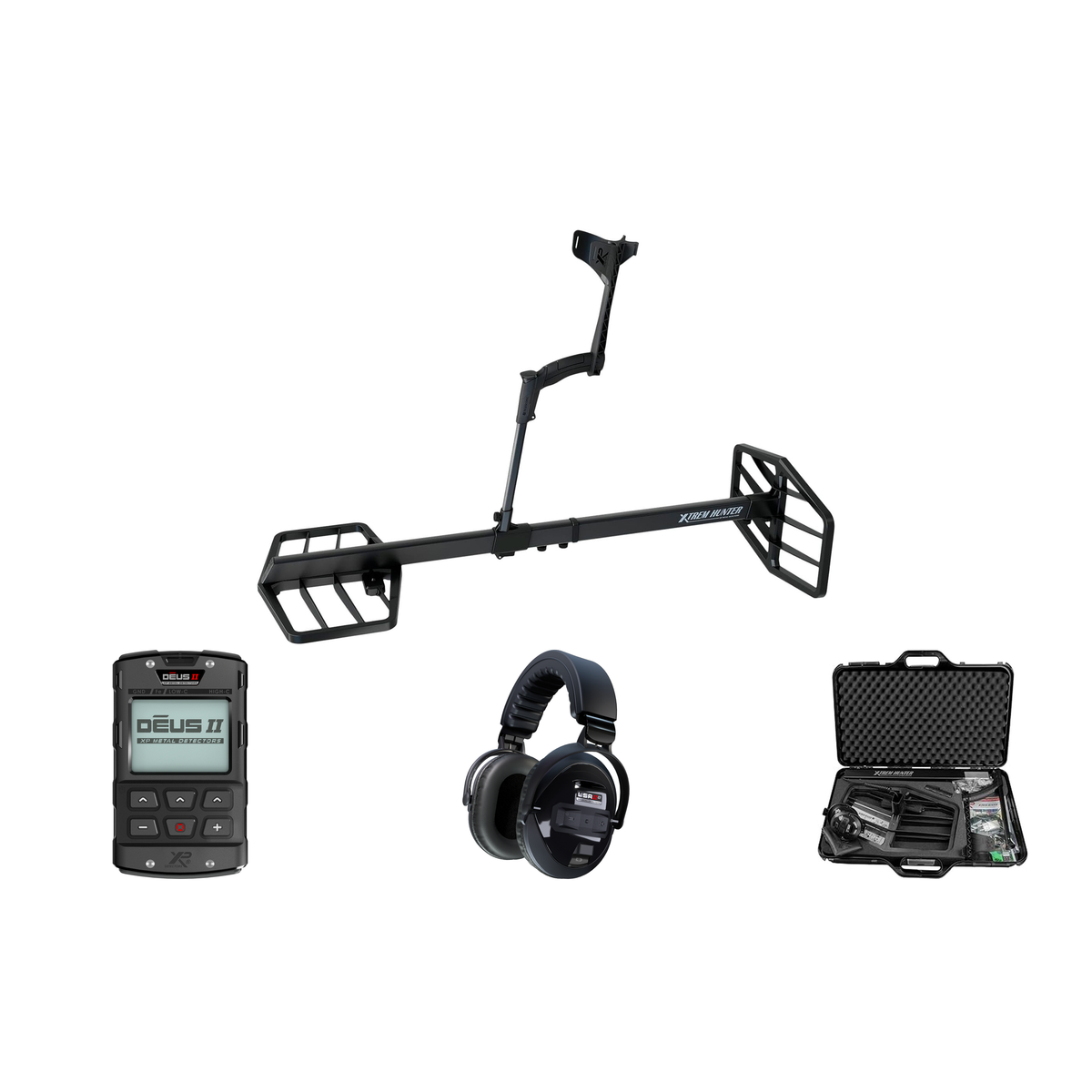
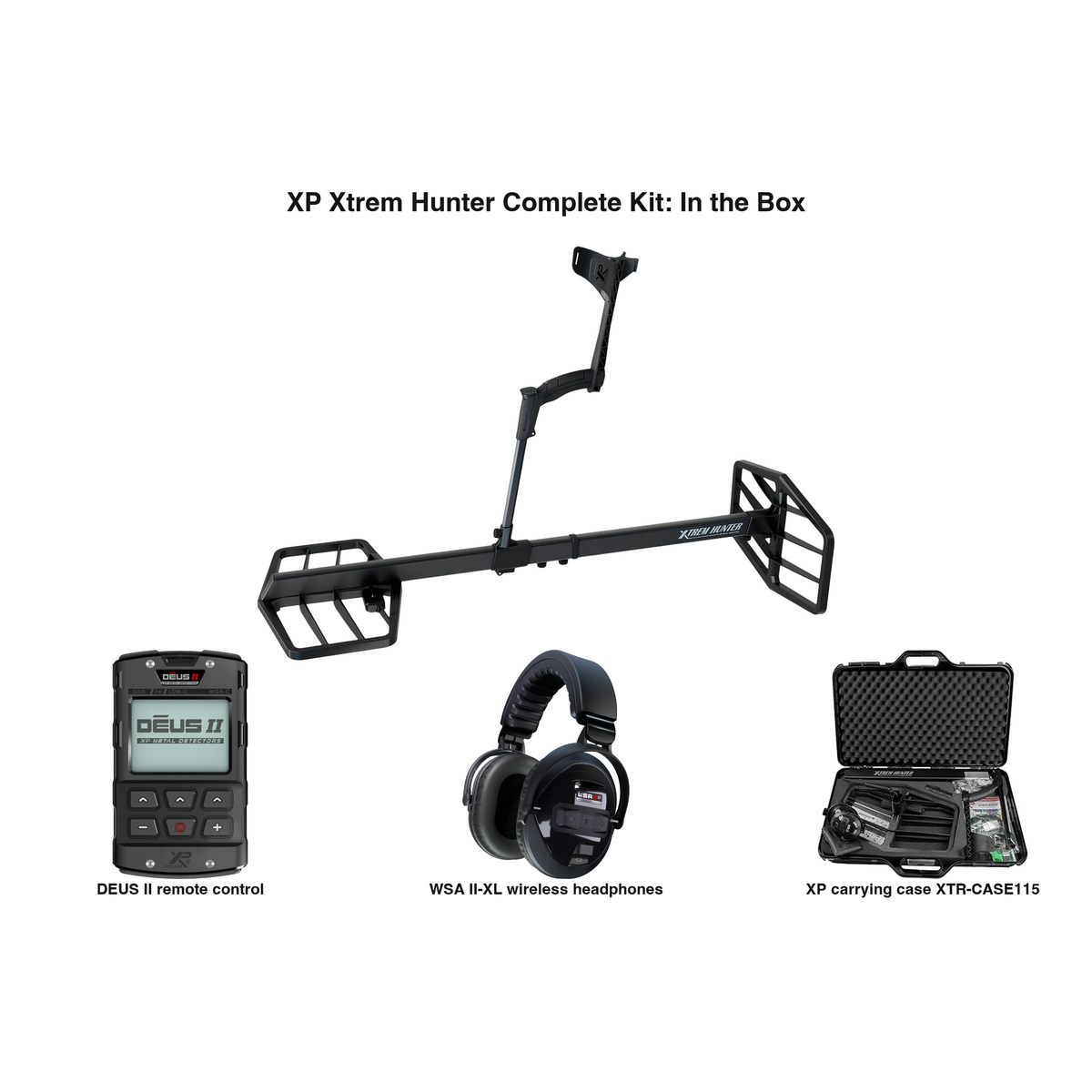
The XP Xtrem Hunter is a fully wireless multi-frequency two-box detector reaching large deep targets up to 5 m (16 ft) per XP. The complete kit: XTR115 TX and RX coils, S-Telescopic stem, DEUS II remote control, WSA II-XL wireless headphones, USB-C cable and charger, and the XTR-CASE115 case. 2.9 kg (6.4 lb) with remote, over 10 hours of battery. Five-year warranty. Software: install DEUS II V4.1 or later on the remote and headphones together (never stop at V4.0; see the software question below).
Exclusive History Seekers bonus: free with every XP Xtreme Hunter
Buy your XP Xtreme Hunter from History Seekers and receive a free 1-year subscription to American Digger Magazine, the definitive print resource for relic hunters, coin shooters, and serious diggers. Real finds, real research, and real history delivered directly to your door. This bonus is available exclusively through HistorySeekers.net.
Notice: the free subscription offer applies strictly to listed prices. It cannot be combined with other discount codes or promotions. If a coupon or promotional discount is used at checkout, the free magazine subscription is excluded.

What Is in the Complete Kit
XP's manual lists the parts; the remote and headphones are the two items marked "depending on version", and this is the version that has them.
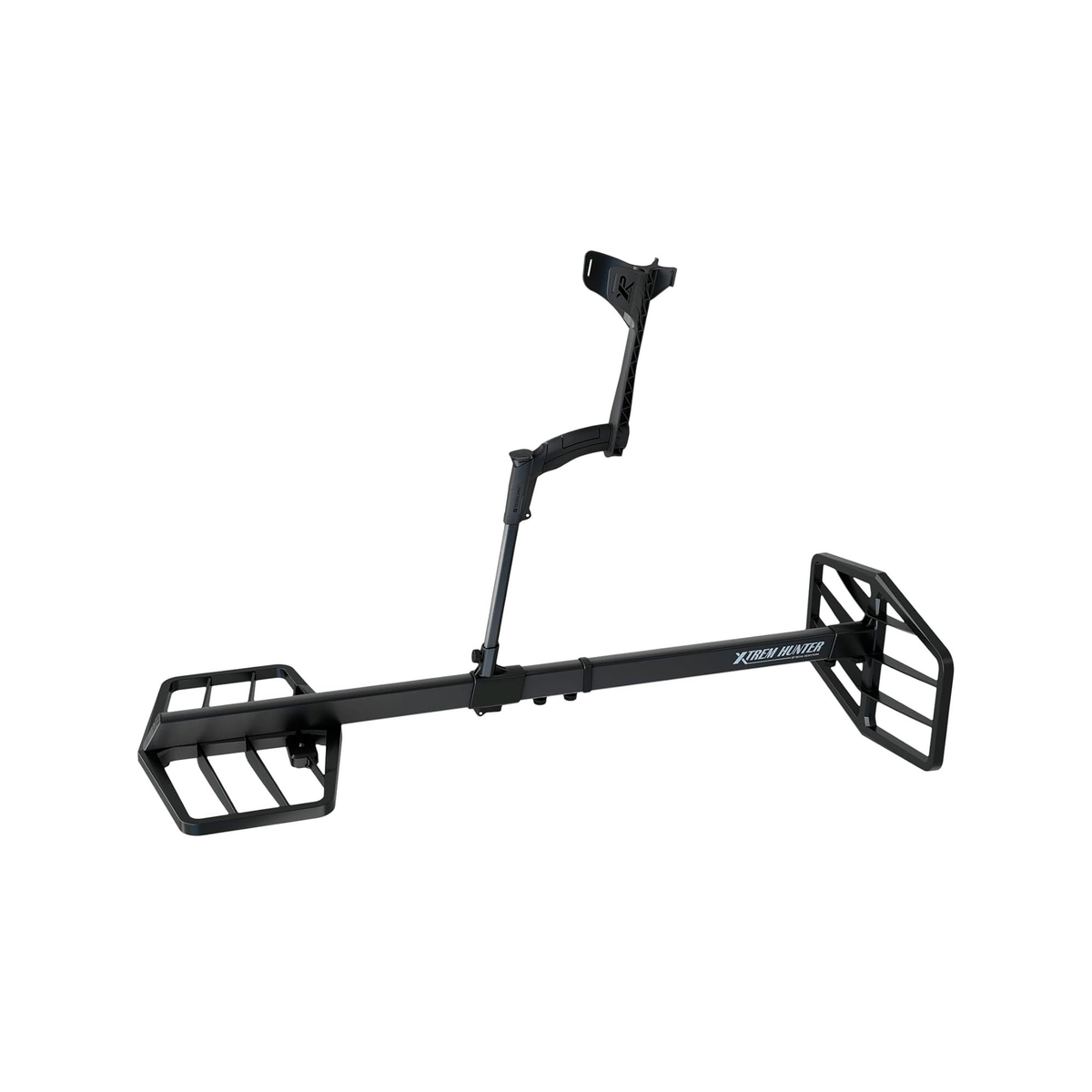
- XTR115 TX and RX FMF coils: the front coil carries the wireless transmitter and the battery, the back coil connects to it by cable, both mounted on the two-part aluminum frame.
- XTR-STEM S-Telescopic stem with adjustable handle and support, plus the carrying strap and the knurled fastening screws (two 5 x 30 mm, four 5 x 16 mm, one 4 x 12 mm).
- DEUS II remote control: pairs to the frame as a coil and switches to the dedicated Xtrem Hunter interface; the same remote runs every standard DEUS II FMF coil sold separately.
- WSA II-XL wireless headphones: XP's low-latency over-ear wireless set, rated IP68 to 1 m (3 ft) for rain and a dropped set, not for diving.
- USB-C charging cable and US charger, the English Xtrem Hunter manual, and the XTR-CASE115 weatherproof XP case.

Why a Two-Box Deep Seeking Metal Detector, and Why This One
XP's manual puts the problem plainly: a conventional detector hears a small target near the surface and a large mass at depth as roughly the same signal, so a nearby nail can mask a deep cache and a day on a good site goes to digging surface junk. The Xtrem Hunter's coil geometry, a transmitter coil in front and a receiver coil behind on a rigid 1.20 m (3.94 ft) frame, makes small surface targets naturally invisible to it, so it can penetrate the top layers of the ground and report what lies beneath them. Earlier two-box machines ran a single low frequency, false-signalled on every height change while walking and needed Sensitivity cut hard to behave; XP's Fast Multi Frequency (FMF) platform reduced that, which is why the factory ground setting works in most ground without retuning. XP rates it to large targets up to 5 m (16 ft) deep; the manual's own examples show a 30 cm (12 in) target still giving a clear but faint signal past 1 m (3 ft). Depth scales with target size, and XP's figure is a large-target ceiling, not a coin depth.
| Spec | XP Xtrem Hunter | What it means in the field |
|---|---|---|
| Technology | Simultaneous Fast Multi Frequency (FMF), two-box TX and RX coils; highest fundamental frequency 7.35 kHz | Stable on more ground than single-frequency two-box machines, with far less retuning while you walk |
| Detection type | Non-motion with adjustable Auto Tune (OFF to 3) | You walk the frame forward over the ground rather than sweeping; a threshold hum breaks over a target |
| Depth | Up to 5 m (16 ft) on large targets, per XP | Caches, strongboxes, artillery shells, tanks and pipes; never single coins |
| Display | Real-time recording of the last 4 seconds with Play / Pause | Signal strength estimates depth, signal duration estimates size; a shallow target draws a double lobe, a deep one a single strong lobe |
| Iron handling | Discri IAR (Iron Amplitude Rejection) OFF to 5 | Moderate iron such as anchors, hammers and horseshoes gives a low tone and shows in gray; small iron is ignored by design |
| Controller | DEUS II remote control (V2.0 or higher), paired as a coil | The remote switches to a dedicated Xtrem Hunter interface; select a standard DEUS II coil in the menu and it is a DEUS II again |
| Software | DEUS II V4.1 is the newest release as of our October 30, 2026 check | Updates the remote and headphones together over USB through XP's online updater |
| Battery | One Li-ion 18650 cell, 11 Wh, in the front coil; more than 10 hours; about 4 hours to charge over USB-C from a 1 A or stronger charger | A full day on one charge; the remote and headphones charge separately |
| Weight and length | 2.9 kg (6.4 lb) with the remote; 1.20 m (3.94 ft) assembled; 5.8 kg (12.8 lb) in the included XP case | Single-person use; the handle and support adjust for balance and search height |
| Weather | Waterproof construction for rain and challenging conditions; case rain and shock proof | A land survey machine; not submersible, no IP rating published for the unit |
| Programs | 1 factory program plus 2 user programs | Save a quiet-site setup and a deep-field setup and switch between them |
| Warranty | Five years parts and labor; batteries and connectors two years | XP's detector-grade warranty on a machine XP itself labels an accessory |
One remote, two machines: the DEUS II remote that runs the Xtrem Hunter also runs every standard DEUS II FMF search coil, so the workflow XP describes is to mark a deep target with the two-box, then switch to a 9 in (22.5 cm) or 11 in (28 cm) DEUS II coil from the coil list, in the Relic program, to confirm it at moderate depth before the big dig. A long press of MENU marks the spot on XP's Go Terrain app, so a survey leaves a map, not a memory.
Who the Complete Kit Is For, and Who Should Buy the XTR-115E Instead
Best for: the cache and relic hunter, archaeologist, utility locator or property surveyor who needs large, deep targets found by one person on land: old homesteads and hoard sites, battlefields and artillery ground, construction and utility surveys, open fields and beaches above the waterline, and who does not yet own a DEUS II remote. Experience level: advanced. A non-motion threshold machine with no target ID asks you to read a signal graph, manage a threshold hum and strip the metal off your body; the reward is depth no swing detector reaches. Same-brand alternative: if you already own a DEUS II remote, the XTR-115E upgrade kit is the same frame and coils without the second remote and headphones, and one remote then runs both machines. Same-brand step down: for coins, jewelry and relics at ordinary depth, an XP DEUS II with a standard FMF coil; for gold nuggets, the DEUS II Gold with the HF2 coil. There is no XP step up: the Xtrem Hunter is XP's deepest machine.
Honest limits: it is designed not to hear coins, jewelry or nuggets; nothing in the kit is submersible; there is no target ID beyond the IAR iron test; and the WSA II-XL headphones in this kit must run DEUS II V4.1 or later, never V4.0. As a specialist deep-seeking unit it is a final sale under our refund policy, so call before you order if you have any doubt.
Xtrem Hunter Settings That Matter
There is no target ID to read on a two-box machine; what you set is how much of the ground, the interference and the surface trash the Xtrem Hunter lets through. XP's manual gives every control a range and a factory value, printed here so you are never guessing, and its own start-of-session order is: pair the frame as a new coil, set the handle so the frame rides well above the surface, strip every piece of metal off your body, run a Frequency Scan, retune, then walk. Change one setting at a time and listen to what it did before you touch the next.
- Search height (the handle, not a menu): the manual's first field instruction is to adjust the handle so the frame stays far enough from the ground to avoid excessive sensitivity to surface targets. In trashy or iron-filled ground, raise it further, or hold the aluminum frame itself; height is the Xtrem Hunter's first discrimination control.
- Sensitivity (0 to 99, factory 85): the most commonly used range is 70 to 90. Cut it to 60 to 75 in trash, near power lines, fences or radio relays, and never test indoors, where urban interference swamps the machine.
- Reactivity (1 to 3, factory 1): low Reactivity is the depth setting: best depth, electromagnetic interference and small targets cancelled, longer signals, less noise from frame movement, and a slower walking pace to match. High Reactivity pinpoints faster with shorter signals and separates targets in cluttered ground. Do not change it often if you want to read sizes on the graph consistently.
- Threshold (0 to 20, factory 0): raises the background hum to mask small variations, which quiets noise but can also bury faint and deep targets. Use it in moderation; a short press of the retune key recenters the hum at any time.
- Auto Tune (OFF to 3, factory OFF): automatic threshold tracking at three speeds. With it on, holding the frame still over a target fades the signal within seconds, and a fast setting can tune out a very large deep mass or a long pipe. Switch it OFF to pinpoint in pure non-motion.
- Frequency Scan (Freq. Shift, 14 channels, auto scan or manual): start every session with the automatic scan, a long press of the top-right key, which picks the quietest of the 14 channels. If noise remains, lower Sensitivity, then Reactivity, then Audio Response, in that order.
- Audio Response (1 to 4, factory 2): higher settings amplify deep targets and make the machine more jittery; 1 gives the most stable threshold and the least ground noise. The manual calls it the key control over the ground response, so set it to your site.
- Ground (59 to 95, factory 87): thanks to FMF the factory 87 works in most cases. In unusually magnetic ground, grab it (hold the ground key two seconds, tilt the front coil toward the ground until the hum settles, release and read the value) or set it manually lower.
- Discri IAR (OFF, 3 or 5; factory OFF): Iron Amplitude Rejection by distance from the coils. 3 rejects shallow iron, 5 rejects shallow and deeper iron; rejected iron gives a low tone and gray on the graph. It works only while you are moving; stop over a target and the audio reverts to the mid tone. In iron-filled ground it can mask large deep targets, so raise the frame instead of pushing IAR higher.
- Audio Type (Square or Pulse, factory Square): Square keeps fixed harmonics and changes only volume with depth and size; Pulse gives stronger sound dynamics and better deep-target perception, through headphones only, never the built-in speaker or a bone-conduction set. A 4-band equalizer sits behind both.
What the 5 m claim and the screen do not do. The frame is not a depth meter: signal strength on the 4-second graph estimates depth and signal duration estimates size, and the manual's reference target is 30 cm (12 in) across, so a coin will not register at any depth. There is no target ID and no discrimination beyond the IAR iron test. It detects only on its bottom side; passing a test target over the top moves the threshold the wrong way, and laying the frame on its side at 90 degrees invites interference. Always wear headphones: the audio range is so wide that the built-in speaker hides the faintest signals. To test one without buried targets, lay out metal samples from 25 cm (10 in) to more than 1 m (3 ft) and pass the frame over them at arm height, about 1.5 m (5 ft).
Where the Xtrem Hunter Works Well, and Where It Does Not
Old homesteads, campgrounds and hoard country: the ground it exists for. Caches, strongboxes and large relics sit below the reach of a swing detector and under the surface trash that defeats it. Grid the site at walking pace on Reactivity 1, mark every single-lobe signal, confirm with a DEUS II coil before you dig.
Battlefields and artillery ground: shells, large shell fragments, cannon parts and buried wagon iron are exactly the moderate-to-large masses the two-box hears, while small targets such as nails and bullets stay invisible to it by design. IAR 3 or 5 separates the horseshoe-class iron from the non-ferrous mass when you need it; raise the frame where the iron is thick.
Construction, utilities and property surveys: tanks, pipes, septic lids, conduit and buried metal structures, located by one person without a second operator. Auto Tune OFF when tracing a long pipe so the tracking does not tune the pipe out.
Beaches above the waterline and open fields: wide, clean ground is where a two-box covers the most area per hour. The construction withstands rain and wet ground; the frame, the remote and the headphones are never submerged.
Towns, power lines and radio masts: the hardest ground for it. XP calls the Xtrem Hunter a highly sensitive device and tells you to keep away from industrial areas, houses and power lines; where you must work near them, Frequency Scan first, then Sensitivity down to 60 to 75, Reactivity and Audio Response down, and expect reduced depth.
Where it is the wrong buy: for coins, jewelry, buttons and gold nuggets, which it is designed not to hear; for anything under water, since no part of the system is submersible; for a hunter who wants a target ID before the dig; and for anyone who will not strip the metal off their body, because the frame, boot shanks and belt buckles falsify its tuning. It is a specialist deep-target survey tool for the hunter who already knows a large target is down there.
Coils, Headphones and Accessories That Fit the Xtrem Hunter
The Xtrem Hunter's own coils are the XTR115 TX and RX pair on the XTR-STEM; XP sells them only in the two kits (the complete kit and the XTR-115E) and as repair parts. Everything else that fits it is DEUS II ecosystem gear, because the DEUS II remote is its controller, and every item below is a product we stock and list on our XP DEUS II fitment page.
Pinpointing coils for the same remote. XP's workflow is two-box first, swing coil second: pair a standard DEUS II FMF coil to the remote and select it from the coil list to confirm a deep target before you dig. The 11 in (28 cm) FMF coil is the all-round confirmation coil, the 9 in (22.5 cm) FMF coil separates best in iron, and the 13x11 in (34x28 cm) FMF coil covers the most ground. (XP's X35 and HF coils are for the original DEUS and the ORX; they do not pair with a DEUS II remote.)
Headphones. Headphones pair with the DEUS II remote, not with the frame, and the manual says to always use them. XP's manual names the WS6, WSA II and WSA II XL by model; XP's V4.1 release lists the remote control, WS6, WSA II (XL), WS6 ST and WSA (XL) ST as the compatible ecosystem, and the remote and headphones must always run the same version. We stock the current ST line: WSA XL ST over-ear headphones, WSA ST headphones and the WS6 ST headphones with control unit. Call before you pair a set you already own to an Xtrem Hunter and we will check the version with you. The Pulse audio type needs headphones; it is not available through the speaker or the BH-01 bone-conduction set.
Pinpointer, carry and finds. The XP MI-6 pinpointer pairs to the same remote and its audio comes through your headphones; the manual also tells you to check your boots with a pinpointer for wire mesh before you start. The XP Backpack 280 is the carry option XP names for the Xtrem Hunter beside the included XTR-CASE115 case, and the XP Finds Pouch carries what a two-box dig turns up.


Frequently Asked Questions
Do I need to own an XP DEUS II to use the Xtrem Hunter complete kit?
No. The XTR-115RCWSA2XLEA is the standalone configuration: the DEUS II remote control and WSA II-XL wireless headphones are in the box, so nothing else is required. The included remote is a full DEUS II remote, so adding a standard DEUS II FMF search coil later turns the same controller into a conventional detector for coins and relics. If you already own a DEUS II remote, the XTR-115E upgrade kit is the lower-cost path; it needs that remote on V2.0 or higher.
Which Xtrem Hunter kit should I buy, the complete kit or the XTR-115E?
XP sells one Xtrem Hunter two ways, each a factory part number. The complete kit (XTR-115RCWSA2XLEA) is the standalone configuration: the XTR115 TX and RX coils, the S-Telescopic stem, a DEUS II remote control, WSA II-XL wireless headphones, the USB-C cable and US charger, and the XTR-CASE115 case, for the hunter who does not own a DEUS II. The XTR-115E upgrade kit holds the coils, the stem, the USB-C cable, the fasteners, the strap and the case only, with no remote, no headphones and no charger, for the hunter who already owns a DEUS II remote on V2.0 or higher; one remote then runs both machines. This page is the Xtrem Hunter complete kit (XTR-115RCWSA2XLEA): coils, stem, DEUS II remote, WSA II-XL headphones, USB-C cable and charger, case.
How deep can the XP Xtrem Hunter detect?
XP rates it to large targets up to 5 m (16 ft) deep, and that figure is a large-target ceiling, not a coin depth. The manual's own signal examples use a 30 cm (12 in) target: a clear double-lobe signal at 30 cm (12 in), a strong first lobe at 60 cm (24 in), and at more than 1 m (3 ft) a clear but faint single signal. Target size, shape, orientation, the ground and your Sensitivity and Reactivity settings decide what you hear; for maximum depth the manual's recipe is clean, non-mineralized ground, a Frequency Scan, lower Reactivity (Ground 70 with Reactivity 1 for deep non-ferrous targets), higher Sensitivity and Audio Response, and headphones.
Can the Xtrem Hunter find gold, coins or jewelry?
It will not find gold nuggets, coins or jewelry, and it is designed that way. The two-box geometry makes small surface targets naturally invisible to it so that it can hear large masses at depth; XP's reference target is 30 cm (12 in) across. Gold enters its world only at cache scale: strongboxes, hoards, large artifacts. For coins, jewelry and relics the XP DEUS II with a standard FMF coil is the tool, and the same remote runs both; for nuggets, the DEUS II's GOLD FIELD program with the HF2 elliptical coil is XP's small-gold setup.
Is the XP Xtrem Hunter waterproof?
Its construction withstands rain and challenging conditions, and the XP case is rain and shock proof, but no part of the system is submersible and XP publishes no IP rating for the frame or the remote. The WSA II-XL headphones in this kit are rated IP68 to 1 m (3 ft), which XP describes as protection against waves or a drop into water, not a diving rating. It is a land survey machine.
What settings should I change first on the Xtrem Hunter?
Follow the manual's ten key points. Pair the frame as a new coil (Option, Pairing, Coil, enter its serial number) and the remote switches to the Xtrem Hunter interface. Adjust the handle so the frame rides well above the surface. Take every piece of metal off your body, boots and belt included. Long-press the top-right key for the automatic Frequency Scan across the 14 channels. Leave Sensitivity at the factory 85 (common range 70 to 90), Reactivity at 1, Threshold at 0, Auto Tune OFF, Audio Response at 2 and Ground at 87, press the retune key, and walk, retuning regularly. If the site is noisy, cut Sensitivity to 60 to 75 and Audio Response to 1 and raise the frame. To confirm a target, switch Auto Tune OFF, retune, and move slowly around it; raising Reactivity speeds up the pinpoint.
How long does the Xtrem Hunter battery last, and how do you charge it?
More than 10 hours per charge from one Li-ion 18650 cell (11 Wh, 45 g) built into the front coil, which also carries the wireless transmitter; the back coil connects to it by cable. A full charge takes about 4 hours over the included USB-C cable from any USB charger rated 1 A or more, between 0 and 40 C (32 and 104 F). The DEUS II remote and the wireless headphones have their own batteries and charge separately; XP warrants batteries and connectors for two years and the detector for five.
What headphones and accessories fit the Xtrem Hunter?
Headphones pair with the DEUS II remote, and the manual names the WS6, WSA II and WSA II XL; XP's V4.1 release lists the remote as compatible with the remote control, WS6, WSA II (XL), WS6 ST and WSA (XL) ST, as long as remote and headphones run the same version. We stock the WSA XL ST, WSA ST and WS6 ST. For confirming deep targets, any standard DEUS II FMF coil pairs to the same remote: the 11 in (28 cm) all-rounder, the 9 in (22.5 cm) separator or the 13x11 in (34x28 cm) coverage coil (X35 and HF coils are for the original DEUS and ORX and do not pair). The MI-6 pinpointer pairs to the remote, the XP Backpack 280 is the carry option XP names, and the Finds Pouch carries the recoveries. Every one is listed on our XP DEUS II fitment page.
Does the Xtrem Hunter need a software update, and which version?
The Xtrem Hunter runs on the DEUS II remote's software and has no separate version of its own. The remote must be on Version 2.0 (V2.0) or higher to pair it (the version shows on screen at start-up). As of our October 30, 2026 check, DEUS II V4.1 is the newest release, and it includes corrections for the XTREM HUNTER. One rule for this kit: XP's V4.0 release worked only with its ST stereo headsets, so the WSA II-XL headphones in this kit need V4.1 or later; update the remote and the headphones to the same version through XP's online updater over USB, because mismatched versions will not work together. Updates are free.
Can one person carry and run the Xtrem Hunter?
Yes. XP designed it for single-person use: 2.9 kg (6.4 lb) with the remote fitted, 1.20 m (3.94 ft) long assembled, with a handle and support that adjust for balance and search height and a carrying strap whose anchor point moves to suit your height. In the included rain and shock proof XP case it is 5.8 kg (12.8 lb), the case alone 2.7 kg (6 lb), and the case measures 725 x 480 x 170 mm (28 x 18.9 x 6.7 in), so it travels as one piece of luggage.
Where can I buy the XP Xtrem Hunter online from an authorized dealer?
Here. History Seekers Metal Detectors is an authorized XP dealer; every Xtrem Hunter kit we sell is new, comes from XP's authorized US distributor under its factory part number, and carries XP's five-year parts and labor warranty (batteries and connectors two years). As a specialist deep-seeking unit it is a final sale under the History Seekers refund policy, so call 256-284-2247 before you order if you have any doubt about which kit fits your DEUS II, and we will talk it through. We price match: send us a competitor's current listing for a new unit and we will verify it.
Who you are buying from
History Seekers is a small American business and a working detecting channel: over 1.1 million people follow our hunts on Facebook and YouTube. Everyone here detects, from the top down: gold, relics, coins, jewelry, even float copper. We hunt with the gear we sell, and the person who answers your call has real dirt time. Every purchase keeps everyday Americans working.
The story is more important than the artifact.
See everything that fits your machine:What Fits the XP Deus II